
Centre County Court Records After Arrest
After a Centre County arrest, the record path splits almost at once. Centre County Correctional Facility and VINE answer the custody question: whether the person is in jail and how custody status can be checked. Court records answer a different question: what charge has been filed, what court has the case, what bail or warrant action exists, and what happened at each stage. In Pennsylvania, many criminal cases start in the Magisterial District Court system by complaint, citation, or preliminary arraignment before felony and misdemeanor matters move toward the Centre County Court of Common Pleas.
The District Attorney's Office is the prosecutor for criminal cases after police file charges. The official county page names Bernie Cantorna as District Attorney and places the office in the Courthouse Annex in Bellefonte. For custody and booking detail, use Centre County jail inmate records. For booking-photo questions, use Centre County jail mugshots. The court record itself is the docket, charging documents, bail entries, hearings, disposition, and sentence history.
Find Centre County Court Records After Arrest
The main public portal is Pennsylvania UJS Case Search. UJS describes public docket sheet search as a free public service, but it also warns that recent entries may not be reflected at once and that docket sheets are not a substitute for a criminal-history background check from Pennsylvania State Police. For Centre County, the Prothonotary and Clerk of Courts page also says public access to case information is available during normal business hours, Monday-Friday, 8:00 a.m. to 4:00 p.m., excluding holidays.
- Open UJS Case Search and choose a search method that fits the information available.
- Search by participant name, OTN, docket number, complaint number, citation number, or incident number.
- Narrow results to Centre County or criminal docket types when the portal provides that option.
- Open the docket sheet and read the charge list, bail entries, scheduled events, and disposition fields.
- If the case is too new, check Magisterial District Court entries, call the Clerk of Courts, or use the records process.
The statewide UJS search interface was captured from the official portal at Pennsylvania UJS Case Search.
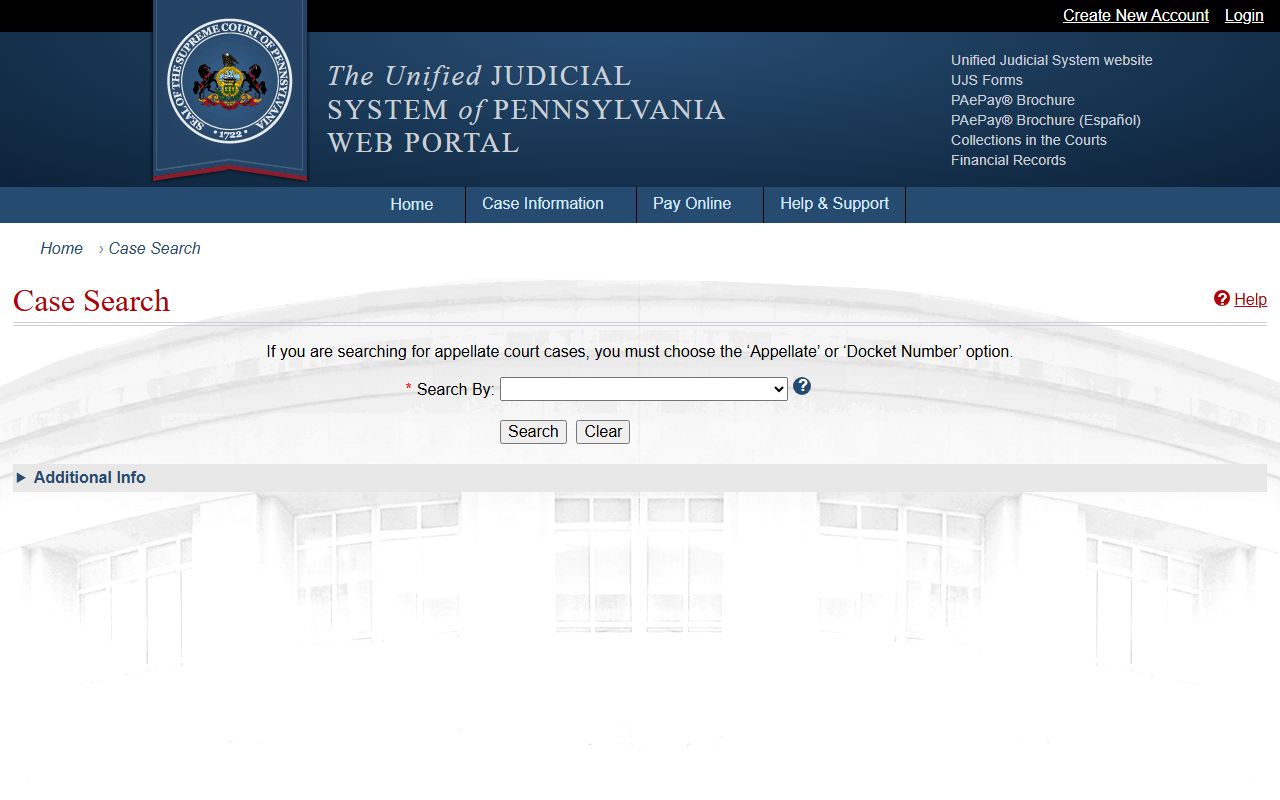
The screenshot reflects why a court-record search often needs more than a name. OTN, docket number, complaint number, court name, and docket type can reduce false matches.
Centre County Court Search Fields
UJS offers several search paths because criminal cases do not all start with the same public number. A person may know only a name after an arrest, while a police report, bail paper, citation, or jail document may include an OTN, complaint number, or docket number. Use the most exact field available first, then broaden the search if no Centre County case appears.
| Field Label | Type | Use | Notes |
|---|---|---|---|
| Search By | Dropdown | Required | Includes participant name, docket number, OTN, complaint number, citation number, incident number, and more. |
| Docket Number | Text | Exact case search | Best when a court paper lists the docket. |
| OTN | Text | Criminal case matching | Useful for matching the same arrest through court events. |
| Participant Name | Text | Name search | Use legal first and last name; common names may need more filters. |
| Docket Type | Dropdown | Narrowing field | Choose criminal when researching charges after jail arrest. |
| Court Name | Dropdown | Narrowing field | Use Centre County courts where available. |
| Scheduled Events Only | Checkbox | Optional filter | Can help find current hearing dates. |
Charges Filed After a Centre County Arrest
A jail arrest record and a court charge record can start close together, but they are not the same document. The jail booking side records custody intake. The court side opens when a criminal complaint, citation, information, or other charging document enters the court system. Felony and misdemeanor cases can move from Magisterial District Court to Common Pleas after preliminary hearing, waiver, formal arraignment, information, plea, trial, sentencing, or diversion events.
| Document | Who Files It | What It Does |
|---|---|---|
| Complaint | Police or prosecutor | Begins many criminal cases and supports early court action after arrest. |
| Information | Prosecutor | Formal Common Pleas charging document after the case moves past the preliminary stage. |
| Indictment | Grand jury process | Less common in routine local cases, but a formal charging path for serious matters. |
The charge list may change as the case moves. Booking charges can be amended, reduced, dismissed, replaced, or resolved by ARD, plea, trial, or sentence. That is why the docket, not the jail listing alone, is the better place to track the court record after an arrest.
Centre County Charge Status
Charge status is the current procedural state of the allegation. A pending charge is still open. A dismissed charge is no longer being pursued in that case. A guilty plea or verdict can become a conviction. Docket entries may also show bench warrants, bail changes, preliminary hearings, formal arraignment, sentencing, probation, or detainer-related events. The words matter because an arrest or charge is not proof that the person was convicted.
| Status | Meaning in Court Records |
|---|---|
| Pending | The charge or case remains open and has not reached final disposition. |
| Amended or reduced | The prosecutor or court changed the filed charge, grading, or count. |
| Dismissed | The charge was ended by court action and is not a conviction. |
| Guilty plea or verdict | The charge resulted in conviction unless later changed by appeal or post-conviction relief. |
| ARD or diversion | A special resolution may avoid a conviction if the person completes court-ordered terms. |
| Bench warrant | The court issued a warrant, often tied to missed court or noncompliance. |
Bond After Centre County Arrest
Centre County's correctional facility FAQ says a person may post the full bond personally or contact a licensed bonding agent who posts bond for a nonrefundable fee. Facility staff cannot recommend a bonding agent. Pennsylvania bail is court-driven, usually set by a Magisterial District Judge at preliminary arraignment or by later court order. A jail custody record may help confirm where the person is held, but the court docket is where bail entries, bail motions, warrants, and next dates are tracked.
| Bond Type | How It Works |
|---|---|
| Full cash bond | The full amount is posted as ordered and later handled through court accounting. |
| Surety bond | A licensed bail agent posts bond for a nonrefundable fee. |
| Recognizance or unsecured bail | The judge may allow release without full cash deposit when conditions are met. |
| No-bond hold | A detainer, warrant, probation/parole hold, ICE/federal hold, or other commitment may block release. |
Release timing can depend on intake volume, cooperation, court paperwork, and holds. The FAQ says evenings, weekends, and holidays are traditionally busiest. Confirm the person is in Centre County custody, ask whether any holds exist, and check the docket before assuming that payment alone will cause release.
Centre County Warrants and Arrest Records
No official Centre County active-warrant search database was located in the research. The Sheriff page says deputies apprehend people with active warrants issued from the courts, and the staff directory identifies a department clerk for warrants at 814-355-6803. UJS dockets can show warrant events such as bench warrant, warrant hearing, warrant review, or withdrawn bench warrant, but a docket search is not the same as a complete warrant database.
A warrant can lead directly to a jail arrest. Police or deputies arrest the person, transport may occur, Central Booking or intake creates the jail record, and the court docket may then add or update the warrant-related event. If the person is arrested outside Centre County on a Centre County warrant, transfer timing can delay the local jail listing and court update.
Charges vs Convictions
Centre County court records after a jail arrest should be read with the presumption that a charge is an accusation. A conviction requires a guilty plea, verdict, or other qualifying disposition. That difference matters for employment, housing, licensing, immigration, and personal decisions, and it is one reason UJS warns that docket sheets are not a Pennsylvania State Police criminal-history background check.
| Point | Charge | Conviction |
|---|---|---|
| Stage | Accusation after complaint, citation, information, or other filing | Final finding through plea, verdict, or qualifying disposition |
| Proof level | Can begin from probable cause and prosecutor filing | Requires proof or admission under criminal procedure |
| Docket effect | May remain pending, be amended, or be dismissed | May lead to sentence, probation, fine, or appeal entries |
| How to verify | Read the current docket and charging documents | Read disposition and sentencing entries |
Sealed and Expunged Records
Pennsylvania public access is shaped by the Right-to-Know Law, CHRIA, court rules, limited-access rules, juvenile protections, and expungement processes. A public docket may omit or restrict certain information even when an arrest happened. Juvenile matters, sealed cases, limited-access records, dismissed matters, ongoing investigations, protected personal information, and some law-enforcement records may be withheld or redacted.
| Record Treatment | Public Effect | Practical Meaning |
|---|---|---|
| Limited access or sealed | Hidden or restricted from ordinary public web access | Some agencies or courts may still have lawful access. |
| Expunged | Removed or treated under the expungement order | Check the court order and Clerk of Courts process for scope. |
| Redacted | Released with private or exempt details removed | Common for protected identifiers, minors, medical details, or safety issues. |
Centre County Court Records Law
The Pennsylvania Right-to-Know Law creates the public-records request framework for state and local agency records, but court records and criminal-history records also follow separate rules. CHRIA governs criminal-history record information, and 18 Pa.C.S. Section 9121 is central to dissemination limits. The county RTK policy also says agencies do not have to create a record that does not exist or compile information into a new format.
Important: A docket lookup is not a consumer report and should not be used for FCRA-covered employment, housing, credit, or insurance decisions.
Centre County Court Offices
The Prothonotary and Clerk of Courts handles public access to case information at 102 S. Allegheny Street in Bellefonte, phone 814-355-6796. The office reports about 2,500 criminal cases yearly and uses CountySuite for civil case search, while criminal court case research should focus on UJS and Clerk of Courts access. The District Attorney's Office is at the Courthouse Annex, 106 East High Street, Room 302, Bellefonte, phone 814-355-6735, and prosecutes criminal cases after charges are filed.
The official Clerk page was captured at Centre County Prothonotary and Clerk of Courts.
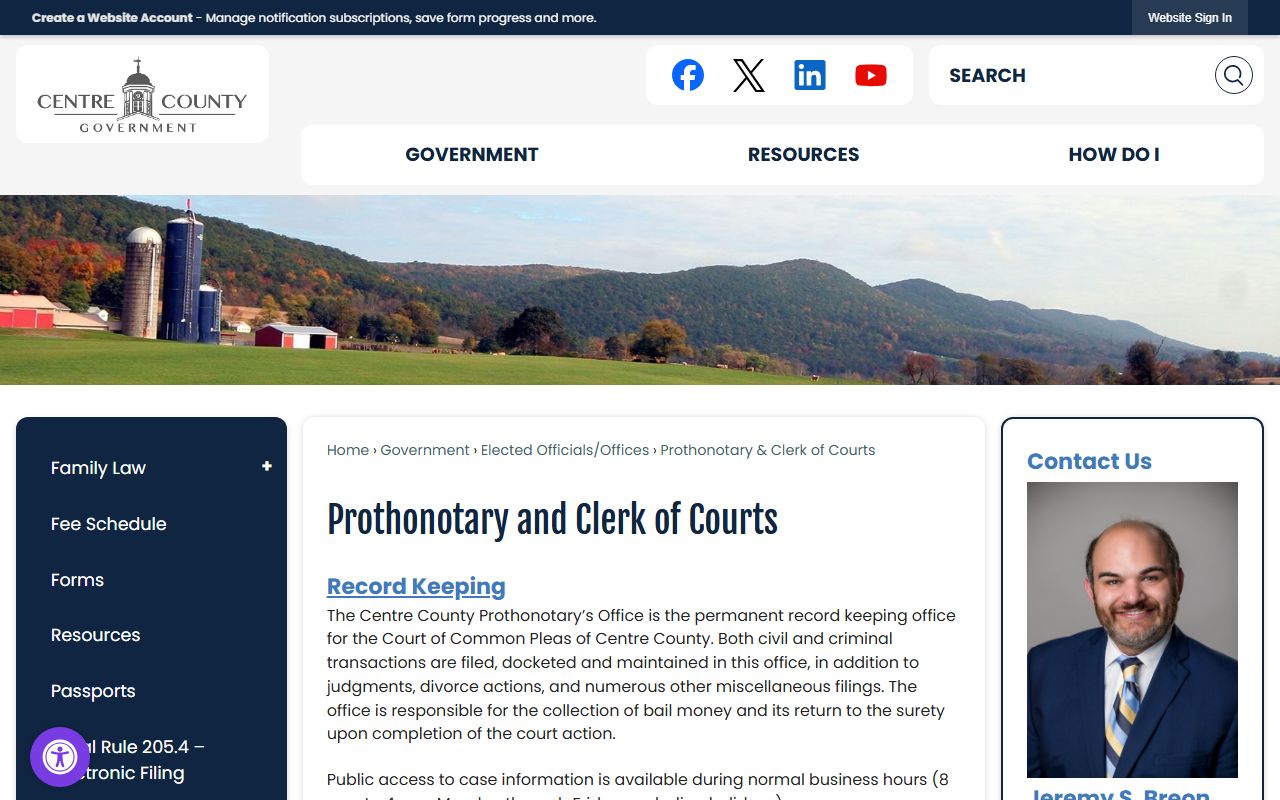
The Clerk information is useful when UJS is too new, too broad, or missing an older or non-web record.
Public Record Search
Sponsored Results